
Table of Contents
- The Questions to Ask Before Pregnancy
- What Pregnancy Can Change
- When Treatment Before Conception Makes Sense
- Ablation and Surgery Before Pregnancy
- Planning Treatment Around Conception
- A Checklist Before You Start Trying
1. The Questions to Ask Before Pregnancy
You know you have a thyroid nodule. It was found a year or two ago. Your biopsy was benign, and your doctor advised monitoring. But now something else is on the horizon: you want to get pregnant.
Suddenly, the nodule that was just a finding raises new questions. Can I get pregnant with it? Will pregnancy make it grow? Should I treat it first? What happens if my thyroid hormone levels change?
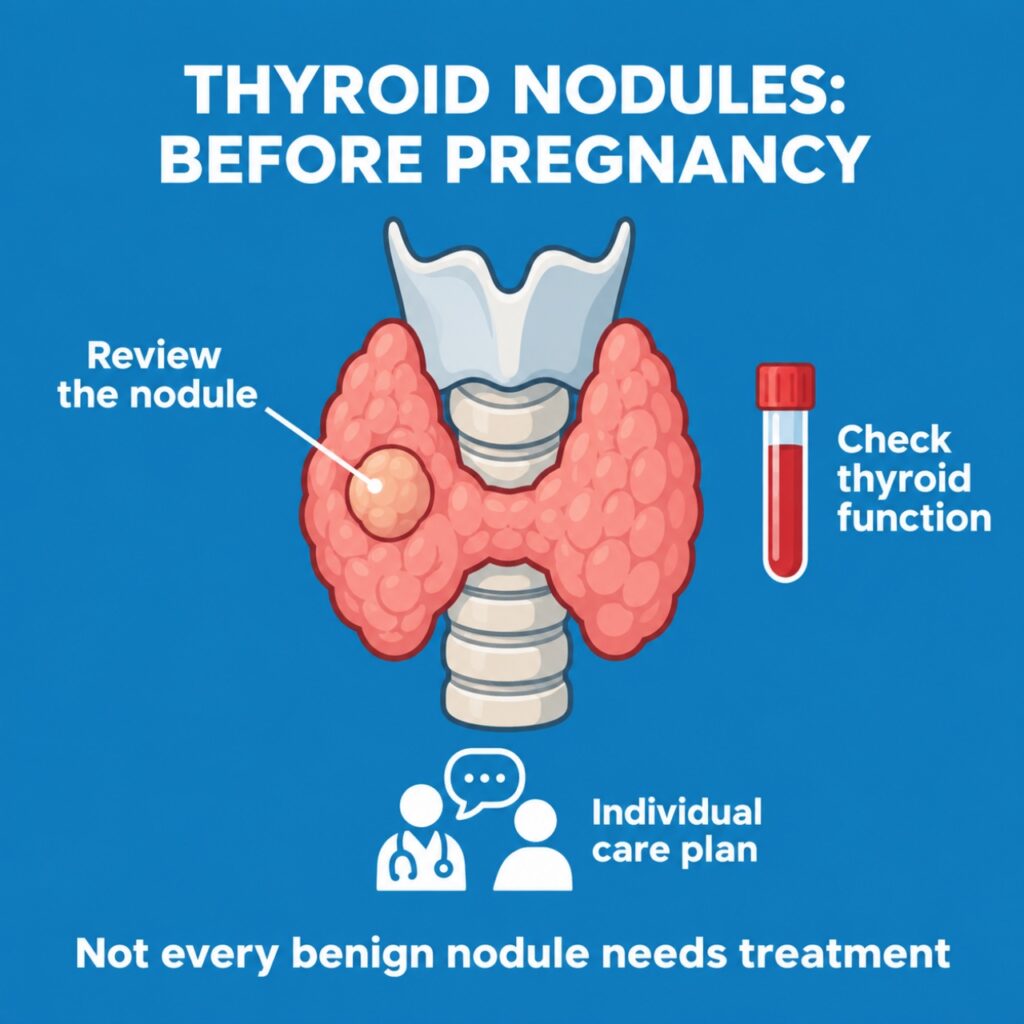
My starting point is to review the nodule and your thyroid function before you conceive. A benign nodule does not automatically need treatment because you are planning a pregnancy. Many nodules can continue to be monitored. Treatment becomes a more relevant discussion when there are pressure symptoms, troublesome enlargement, excess hormone production or uncertainty about the diagnosis.
An early review gives us time to decide what your particular nodule needs and how that fits with your pregnancy plans.
2. What Pregnancy Can Change
Your thyroid works differently during pregnancy. The pregnancy hormone hCG can stimulate the thyroid, especially in the first trimester. Thyroid hormone requirements also change. Blood tests therefore need to be interpreted in the context of pregnancy.
Some nodules enlarge, while others remain stable. Growth is not inevitable, and a change in size does not by itself mean cancer. Ultrasound appearances, symptoms and the previous biopsy result help us decide whether any change needs further assessment. There is no single growth percentage that predicts what your nodule will do during pregnancy.
Investigations and treatment need more planning. Ultrasound and, when indicated, fine-needle aspiration cytology (FNAC) can be performed during pregnancy. Radioisotope thyroid scans and radioactive iodine treatment are avoided during pregnancy. Elective thermal ablation is generally deferred because pregnancy safety evidence is limited. If urgent treatment is needed, a specialist team can assess the options; pregnancy does not mean that treatment is impossible.
If you are already pregnant, arrange a review without assuming that you have missed your opportunity for care. Rapid neck enlargement, persistent voice change or new swallowing difficulty should be assessed promptly. Difficulty breathing needs emergency assessment.
3. When Treatment Before Conception Makes Sense
If treatment is indicated, completing it before pregnancy can give you time to recover and establish a follow-up plan. The reason for treatment should come from the nodule assessment, rather than from the pregnancy plan alone.
An overactive nodule needs particular attention. A toxic or autonomously functioning nodule produces thyroid hormone independently. Overt hyperthyroidism should be addressed before conception, with the choice of treatment discussed alongside your endocrinologist and obstetrician.
Pressure symptoms deserve an assessment. If the nodule is causing difficulty swallowing, discomfort or a visible swelling that troubles you, we can discuss whether treatment would help. A large nodule does not necessarily mean that the gland is producing too little hormone; that is a separate question answered by blood tests.
An uncertain diagnosis should be clarified. If the ultrasound has suspicious features or the biopsy was inconclusive, further evaluation may be needed before selecting any treatment. Ablation should not be used simply to bypass that uncertainty.
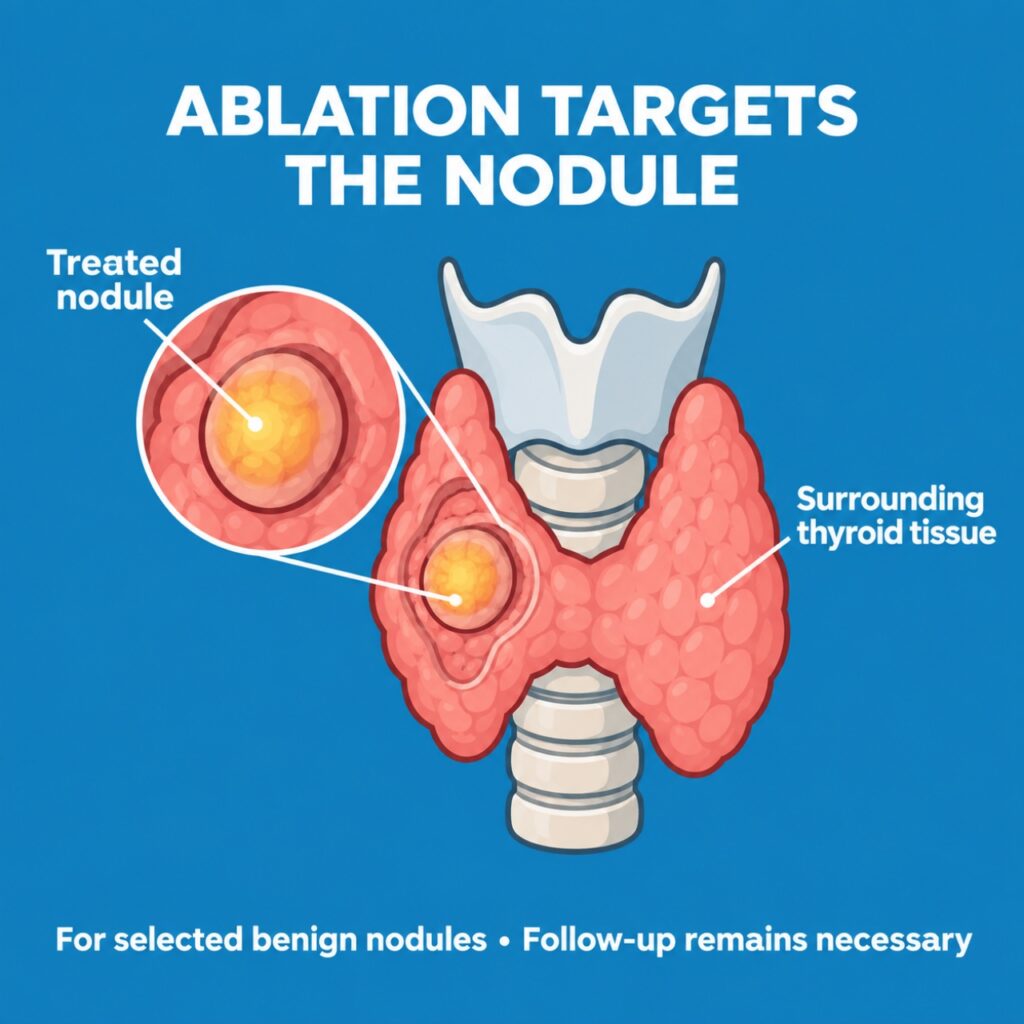
For a stable, well-assessed benign nodule without symptoms or hormone excess, monitoring may remain appropriate. Thermal ablation is generally considered for selected benign nodules that cause symptoms or cosmetic concerns.
4. Ablation and Surgery Before Pregnancy
When a confirmed benign nodule needs treatment, thyroid nodule ablation and surgery may both be options. Suitability depends on the nodule’s size, composition, position and function, as well as your preferences. Cystic nodules and overactive nodules can require a different discussion from a solid, nonfunctioning nodule.
Ablation aims to preserve healthy thyroid tissue. It treats the nodule without removing the whole gland. Thyroid function is often maintained, but that is not a guarantee that medication or blood tests will never be needed. Follow-up remains necessary, and some nodules need further treatment.
The effect of surgery depends on how much thyroid is removed. Total thyroidectomy requires lifelong thyroid hormone replacement. After removal of one lobe, the remaining lobe may make enough hormone, although some patients still need levothyroxine. Surgery can be the more appropriate option when the diagnosis or anatomy makes ablation unsuitable.
Levothyroxine can be managed during pregnancy. If you take it, plan your pregnancy care with your doctor. The dose often needs adjustment, and thyroid blood tests are commonly checked about every four weeks in the first half of pregnancy. A treatment plan should support good hormone control without making you feel that needing medication prevents a healthy pregnancy.
I would discuss these trade-offs with you alongside your pregnancy timeline. You can also browse our thyroid and other patient education articles.
5. Planning Treatment Around Conception
Before you start trying: Bring your previous ultrasound, biopsy reports, blood tests and medication list. We can decide whether the ultrasound needs updating. TSH is usually the starting blood test; free T4, T3 or thyroid antibodies may be added when your history or initial results make them useful. Everyone does not need the same full panel.
If ablation is chosen: Allow time for recovery and the planned clinical, ultrasound and thyroid function review. Shrinkage develops over months, and the response varies. Follow-up commonly includes an assessment around three months, with earlier review when needed.
Before trying to conceive after treatment: Agree the timing with your treating team using your recovery, thyroid function and any remaining treatment needs. I would not give every patient a fixed three- or six-month waiting period after thermal ablation. That interval needs an individual clinical basis. Thermal ablation is different from radioactive iodine treatment, which has separate pregnancy restrictions.
When pregnancy is confirmed: Tell your obstetrician and thyroid team about the nodule and any previous treatment. Follow your agreed blood-test and medication plan. Normal results before conception do not remove the need to consider thyroid health during pregnancy.
This planning should also take account of your age, fertility history and any assisted conception treatment. There is no reason to impose a year-long delay on every woman with a benign thyroid nodule.
6. A Checklist Before You Start Trying
- Review the ultrasound and its risk assessment with your doctor, identifying which TIRADS system the report uses. You can also read our TIRADS and Bethesda guide.
- Review the previous FNAC result. Repeat biopsy depends on ultrasound risk, relevant growth, an inadequate result or the requirements before ablation; it is not automatically due every two years.
- Check thyroid function and review current medication with your doctor.
- Discuss whether monitoring, ablation or surgery best fits the findings and your pregnancy plans.
- If you have treatment, agree the recovery checks and the timing of conception with your treating team.
- Keep a plan for whom to contact and when to check thyroid function once pregnancy is confirmed.
For me, the purpose of a pre-pregnancy review is to help you make a clear, proportionate decision. Some nodules need treatment before conception. Others need a sensible monitoring plan. The next step is to establish which applies to you.
To discuss your thyroid nodule before pregnancy planning:
Phone / WhatsApp: +91-9211978100
Email: [email protected]