
Table of Contents
- The Routine You Have Memorised
- How Fibroids Can Contribute to Painful Periods
- What Painkillers Can and Cannot Do
- What May Change After Fibroid Treatment
- If This Sounds Like Your Life
1. The Routine You Have Memorised
You may recognise the pattern before your period starts. Your lower back aches. Your pelvis feels heavy. Then the cramps arrive, and you find yourself reaching for a hot water bottle and the medicine you keep for these days.
Perhaps you have cancelled a meeting, missed a family event, or spent a weekend resting because the pain made your usual activities difficult. Some months are manageable. Others are much harder.
Being told that painful periods are common does not make that disruption easier. If pain repeatedly interferes with your life, I recommend getting it assessed rather than simply accepting it as your normal.
Fibroids can be one explanation, but they are not the only one. Endometriosis, adenomyosis and other conditions can also cause painful periods. Some women have significant menstrual cramps without an underlying pelvic condition. Finding fibroids on a scan does not, by itself, prove they are causing the pain.
2. How Fibroids Can Contribute to Painful Periods
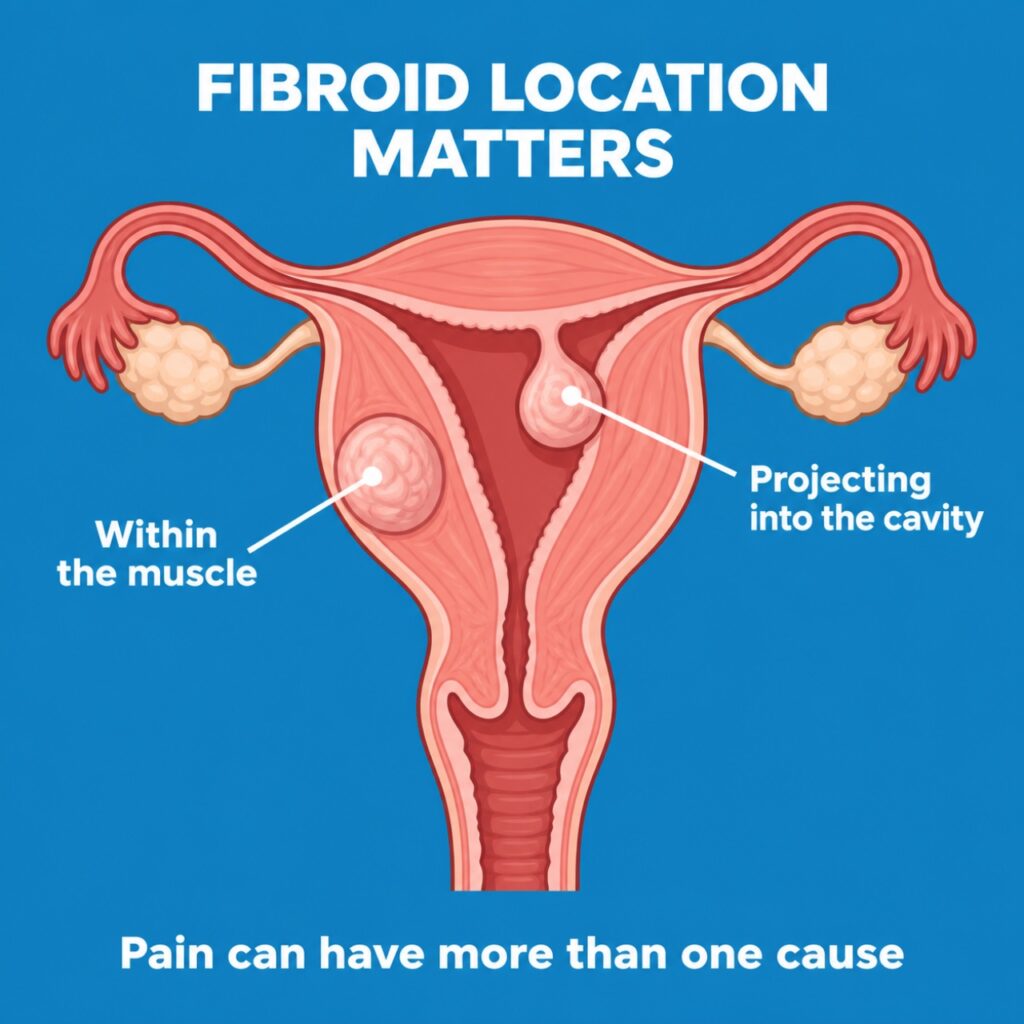
During a period, the uterus contracts as its lining is shed. Fibroids are non-cancerous growths arising from the muscle of the uterus. Their size and position influence the symptoms they may cause.
- Fibroids near the uterine cavity can affect bleeding. Submucosal fibroids project into the cavity, while some intramural fibroids within the uterine wall distort it. Fibroids may be associated with heavier or longer periods and menstrual cramps.
- Larger fibroids can cause pressure. An enlarged uterus may contribute to pelvic heaviness or lower back discomfort. Pressure symptoms can occur between periods as well as during them.
- Symptoms vary. Some women have several fibroids and little discomfort; others have symptoms that need treatment. The scan findings must be considered alongside the bleeding pattern and the nature of the pain.
It is too simple to describe every painful period as a blockage that makes the uterus work harder. I would also want to know whether pain occurs between periods, during sex, or when passing urine or stools. These details help guide the assessment.
3. What Painkillers Can and Cannot Do
Mefenamic acid, ibuprofen and naproxen belong to a group of medicines called non-steroidal anti-inflammatory drugs, or NSAIDs. They can be appropriate treatments for menstrual cramps. Needing medicine during your period does not mean you have done anything wrong or that you must have a procedure.
NSAIDs do not shrink fibroids. However, symptom control can still be a reasonable treatment goal. NSAIDs are among the options for heavy menstrual bleeding and can be continued when they are beneficial.
The reason to review your treatment is persistent disruption: pain that remains difficult to control, worsening symptoms, heavy bleeding, or side effects from the medicine. Fibroids do not all grow steadily, and worsening pain should not automatically be blamed on growth.
NSAIDs can cause stomach irritation and, less commonly, ulcers, gastrointestinal bleeding or kidney problems. Risks depend on the medicine, dose, duration, your health and other medicines you take. Use them as prescribed, and do not combine two NSAIDs, such as ibuprofen and mefenamic acid, unless your doctor specifically advises it. A doctor or pharmacist can help you choose an appropriate option.
4. What May Change After Fibroid Treatment
If the assessment suggests that fibroids are contributing to your symptoms, we can discuss treatment options. These may include medicines, uterine fibroid embolisation, myomectomy or other approaches suited to the fibroids and your goals. Hysterectomy is also an option in selected circumstances. There is no single best treatment for every woman.
Uterine fibroid embolisation, or UFE, is also called uterine artery embolisation. An interventional radiologist guides a catheter into the arteries supplying the fibroids and delivers tiny particles that block their blood supply. The fibroids gradually shrink, and bleeding or pressure symptoms may improve.

UFE does not guarantee pain-free periods. Pain may persist if another condition is contributing, and some women need further treatment. Cramping can be substantial immediately after UFE and requires a pain-control plan. Many women resume usual activities within one to two weeks, although recovery and symptom improvement vary.
Risks include infection, bleeding or bruising at the catheter entry site, passage of fibroid tissue, and effects on ovarian function or periods. Occasionally, complications or persistent symptoms require surgery. Future pregnancy plans need a specific discussion because preserving the uterus does not guarantee preserved fertility.
For more detail, read my post-UFE recovery guide. Your own discharge instructions and clinical review should guide decisions about symptoms after treatment.
5. If This Sounds Like Your Life
If painful periods regularly disrupt your work, relationships or daily activities, arrange an assessment. You do not need to wait until you can no longer cope.
Start with the history. Note when the pain occurs, how heavy the bleeding is, and which medicines help. A pelvic ultrasound may be appropriate to look for fibroids and other possible explanations. The type of scan and any additional investigation depend on your symptoms and examination.
Check for anaemia if bleeding is heavy. A complete blood count is recommended for women with heavy menstrual bleeding. Pain and heavy bleeding can occur together, but one does not prove the other.
Discuss your priorities. These may include pain relief, lighter periods, retaining your uterus or planning a pregnancy. I want the treatment discussion to address what matters to you as well as what the scan shows.
Seek urgent medical assessment if pelvic pain is severe or worse than usual and painkillers have not helped. If heavy bleeding is accompanied by fainting, marked dizziness, breathlessness or feeling acutely unwell, seek urgent care rather than waiting for a routine appointment.
To discuss your painful periods with me:
- Book an Appointment
- Phone / WhatsApp: +91-9211978100
- Email: [email protected]
Pain relief matters. So does understanding why you need it and whether your current treatment is meeting your needs.